 Little is known about Grandad Lazarus and his family after their arrival in South Africa, but I have caught glimpses of them in the South African archives. It seems that they settled in Boksburg, a small town east of Johannesburg with a growing population of Jewish immigrants.
This post comes with a health warning: I have chosen to use the language of the day which is often highly offensive.
 Early Witwatersrand, Wellcome Trust.
All roads lead to gold
It is likely that Samuel continued to be a hawker, or ‘smous’ as they were known in South Africa. Once gold mining was established in the area, however, opportunities for small traders grew. Perhaps he worked for relatives in the concession stores that had sprung up to cater for mine workers.
In his novel The Book of Isaac, Jeremy Gavron writes about one such Jewish immigrant family struggling to make a living in a humble mine concession store. The wife of the eponymous Isaac writes home saying, “I wonder what you would think if you saw your sister in this iron hut, behind this iron store on this square of dust”. Isaac’s brother, on the other hand, was one of those who made good. He started as a meat trader and butcher and used his profit to build a grand store, one of the day’s shopping malls.
Cecelia Muller, an immigrant granddaughter, writes in The Jewish Herald that the concession store “was referred to, not unkindly, as 'Jewstore' by the mining families. They consisted of several departments under one roof. There was the butchery
and the 'Eating House', the Native miners could try boiled tripe, whole sheep's head and cooked flank—the oily, flat odour pervaded the store at cooking times, when the meat was prepared in huge cauldrons by the black chef wearing an old sack for an apron! The customers brought their own tin or enamel plates and paid 5c, or 10c per portion. They sat at long, rough tables with benches alongside, noisy, laughing and at ease with their blankets hanging loosely over a shoulder.”
Many Jewish immigrants made their fortunes in this way, and it was not always honourable. Historian Robert Edgecome writes about a pair of brothers who devised a system whereby mineworkers were permanently indebted to the mine store by credit, provided in the form of a token. This guaranteed a monopoly in which goods could be sold way above market value.
These brothers were named as Samuel and Charles Lazarus—too young to be great-grandfather’s generation, but likely to be relatives of some sort. Possibly even grandad’s brothers.
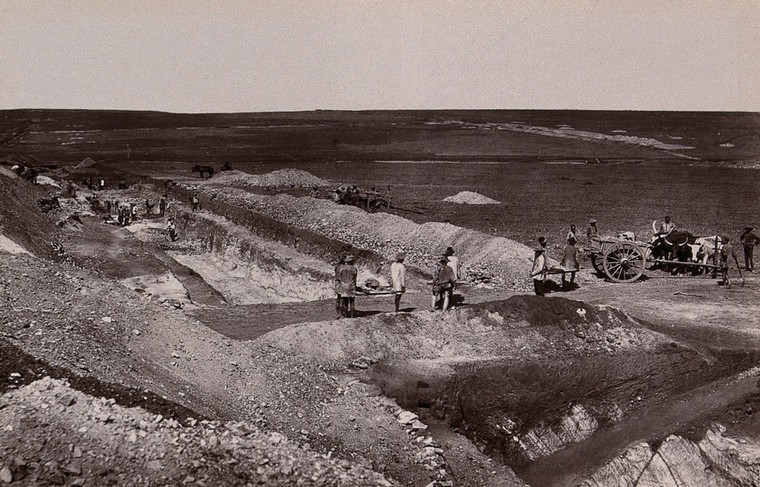 Early gold mine diggings, Main Reef. Wellcome Trust.
Labour tout
Grandad’s life and work was not a topic of discussion in our family, but the South African archives suggest that he was determined to better himself, by fair means or foul. In 1910 he applied for, and was granted, a license to become a labour tout.
Labour touts were freelance labour recruiters who made a living off rural people seeking work in the towns and mines. Newly arrived black work-seekers had to have their wits about them to avoid falling into the clutches of the numerous touts who might send them to low-paid jobs in remote rural areas.
Touts were banned in certain areas where the mines had their own recruiting system, but this did not prevent them from operating. One official recruiter noted that Lazarus “recruited every boy down at the pass office…I put on detectives and we trapped the fellow Lazarus, but the government refused to take any action at all.”
Grandad Philip Lazarus expanded and founded his own company, The Lazarus Native Labour Organisation. They were also active in the rural north of the country and recruited labour from neighbouring Rhodesia (now Zimbabwe). Rhodesian workers were particularly prized for their willingness to work for low wages and to sign up to longer contracts.
According to the official quoted above, Lazarus and company was much more than a recruiting agency. The letterhead described the company as “grain brokers, commission and general agents, railway contractors, manufacturer’s agents and general storekeepers. The firm had a network of trading stores in Basutoland (9), Swaziland (4) The Transvaal and Bechuanaland (2), the Cape and Natal (I each)”.
The official continued. “Later in 1914 Lazarus applied for permission to hire voluntaries [work-seekers] in Boksburg, Benoni and Germiston as well but the Native Labour Bureau refused the applications,” he writes. “Almost from the start bureau officials recognized that Lazarus and company was “not in fact a bona fide organization endeavoring to introduce labour from native areas... Despite this, permission to engage voluntaries in Johannesburg remained in force until 1918. Presumably Native Affairs officials felt that the services of the company in sweeping the streets of unemployed blacks outweighed the problems created by the touting. Lazarus may have been politically well connected although there is no evidence of this.”
ZK Matthews, a respected academic of the time, criticised the Lazarus Native Labour Organisation’s methods in the Northern Transvaal for “dealing out workers indiscriminately to domestic service, farms, sugar, mines, mills”. Sociologist Helen Braford describes the system as forced labour, “black slave traffic on a grand scale”.
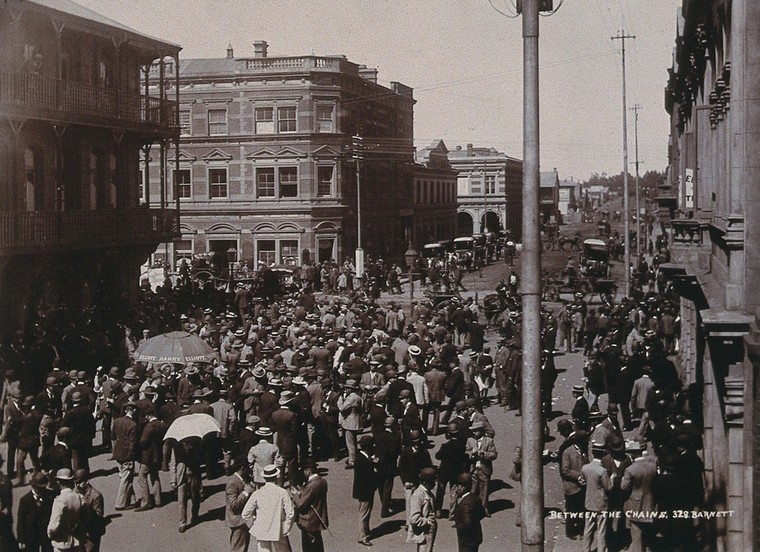 Johanneburg business distric, 1896, Wellcome Trust.
A man of substance
The Lazarus surname crops up repeatedly in the archives for recruiting illegally and for poor labour practices. Though there may have been more than one Lazarus labour tout, it seems unlikely. Some examples:
1921 - Illegal recruitment by Lazarus of five natives at Germiston.
1923 - Recruitment of underage natives by Lazarus Native Labour Organisation.
1924 - Assault of three natives by Lazarus and his foreman in Germiston.
1927 - Two picannins [children] recruited in 1925 by Lazarus failed to come home.
1934 - Estate of deceased natives employed by PH Lazarus labour agent – complaint by Native Commissioner, Durban
Through these means grandad became a wealthy man, a man of substance. His self-penned CV in the 1926 Jewish Yearbook has a Trumpian ring. He describes himself as a Director of Companies, Major (6 medals), head of several sports organisations and Chairman of the Isipingo Country Club.
Grandad and me
Its taken me a long time to summon the emotional energy to post this piece. I knew I should expend time and money attempting to access the detail in all these records. But my heart was not in it. It feels important to acknowledge that, given the history of the country, there is likely to be something dishonourable in the ancestry of most white South Africans. In my case, both my grandfathers were engaged in the mining economy that was the cornerstone of what later became the apartheid system.
All we can do is try and understand the forces—personal and political—that caused them to behave the way they did. In the case of Grandad Philip, who grew up in a penniless immigrant family, he was motivated to outrun his destiny. But the way he chose to do this is difficult to accept.
References
Bradford H. Getting away with slavery — capitalist farmers, foreigners and forced labour in the Transvaal, 1920—1950. History Workshop, University of the Witwatersrand, 1990.
Edgecome R. The making of class. History Workshop, University of the Witwatersrand, 1987.
Kros C. Deep rumblings Z K Matthews.. History workshop, U Witwatersrand, 1990.
Muller, C. Concession Stores. The Jewish Herald. 14 September 1976.