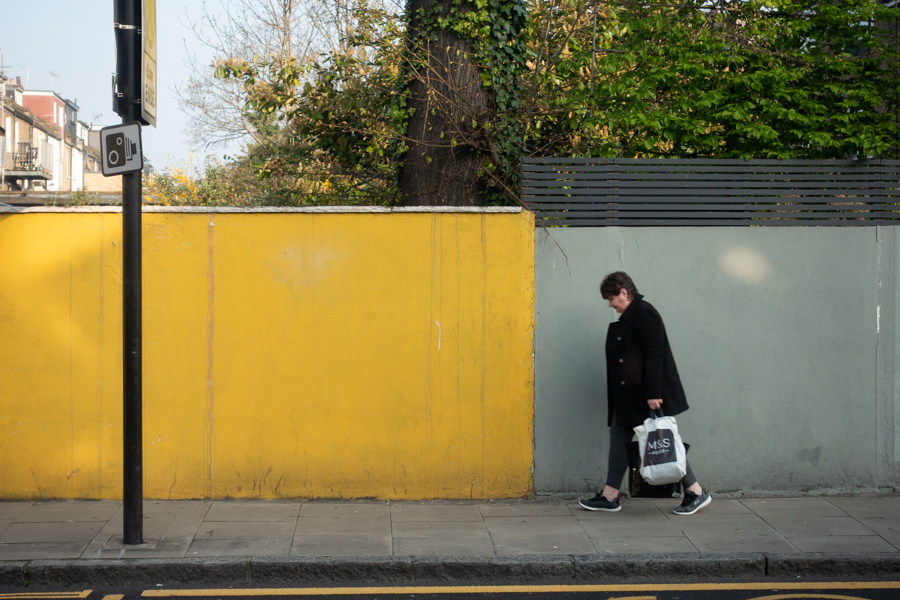
 Lockdown walk, Highbury London, 9 April 2020. Photograph Lesley Lawson.
According to my activity tracker, in the past four years I have walked the length of the Great Wall of China. This has been achieved, not by great adventure, but largely by pounding the streets of London.
My “street haunting”, as Virginia Woolf called it, began in earnest during the COVID lockdown when I could only venture as far as my feet would take me. I have always been a walker, but up until this point my perambulations were either of the A-to-B type or the “going-for-a walk” type. Being confined to the extended neighbourhood was a revelation, bringing health to the body and joy to the soul. With the aid of my camera, I succumbed to the charm of the quotidian… and without realising it, walked further every day. Among other things, I discovered underground rivers, and a ring of parks that surround my home. (You can read more about this here).
These next few posts take an in-depth look at the evidence on a range of health-giving activities for older people. Walking is the most obvious place to start. It is a most gentle and democratic sport, requiring only a good pair of shoes (and socks), and can be easily worked into daily life. Walking and wandering have multiple gifts for body and mind, even stimulating creative thinking and problem solving. On the other hand, a sedentary lifestyle is universally acknowledged to increase illness and shorten lives.
Step counts and health outcomes
COVID wandering aside, I have strived, but not always succeeded, to do my 10,000 steps a day—a number I had accepted without questioning. But new evidence suggests that 7,000 steps, or even less, may bring great health benefits that translate into longer healthy years.
Two recent reviews analyse the scores of scientific papers on the health impact of walking. They both comment on the arbitrary nature of the 10,000-step goal but reach different conclusions as to how many steps are needed to improve our health.
A 2023 paper in the Journal of Preventive Cardiology looked at 17 studies (covering 27, 000 participants) and analysed the effect of up to 20,000 steps a day on deaths by all causes, and by cardiovascular disease. They found:
- Each 1,000-step increment correlated with a 15% decrease in all-cause mortality;
- Each 500-step increment correlated with a 7% decrease in risk of death from cardio-vascular disease; and
- The more steps the better, with a lower cut-off point of 3,867 steps for all-cause mortality and 2,337 steps for cardiovascular mortality.
The authors emphasise that it is the number of steps a day that counts, rather than the intensity of exercise.
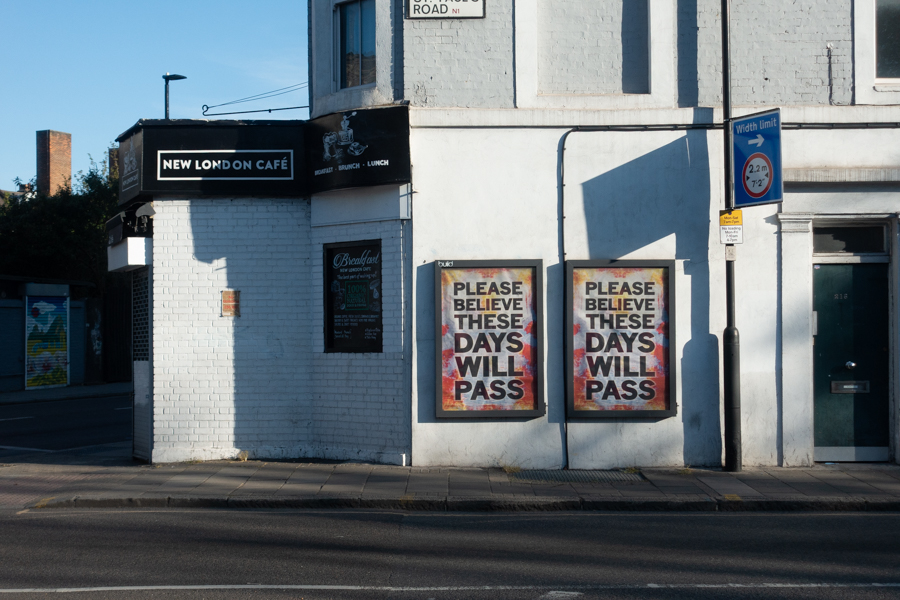 Lockdown walk. Highbury London. 15 April 2020. Photograph Lesley Lawson.
A 2025 paper in Lancet Public Health looked at the impact of daily step-count on a much wider range of health outcomes. It reviewed 88 studies investigating the relationship between walking and all-cause mortality, cardiovascular disease, cancer, type 2 diabetes, cognitive outcomes, mental health outcomes, physical function and falls. They found that, in comparison with those who walked 2,000 steps a day, the group that walked 7,000 had positive outcomes such as:
- 47% lower risk of all-cause mortality;
- 25% lower risk of cardiovascular disease incidence;
- 47% lower risk of cardiovascular disease mortality;
- 37% lower risk of cancer mortality;
- 14% lower risk of type 2 diabetes;
- 38% lower risk of dementia;
- 22% lower risk of depressive symptoms, and
- 28% lower risk of falls.
The authors concluded that although 10,000 steps may be a good target for those physically active, 7,000 may be more realistic for older people and result in clinically meaningful improvements in health.
Another recent review in the Journal of Sports Medicine found that even the act of standing up after meals lowered blood glucose—a contributor to cardiovascular disease—but light intensity walking worked even better.
For the unscientifically minded, the conclusion is: the more you move the better, but any little bit beats sitting in a chair.
 Lockdown walk. Highbury, London. 29 April 2020. Photograph Lesley Lawson.
Surprising benefits
Other researchers have identified some surprising benefits of walking. For example, a Harvard Health publication of 2019 summarises studies that conclude the following:
- A brisk daily walk can counteract obesity-promoting genes;
- A 15-minute walk can curb cravings for chocolate and sugary snacks;
- A 5-6 mile walk a day can prevent arthritis, and shorter walks can ease arthritis pain;
- A 20-minute walk, five days a week, can boost the immune system. Of the 1,000 study participants who did this, 43% had fewer sick days and if they did get sick it was milder and for a shorter time.
Other studies quoted by the British Heart Foundation found that walking Improved the duration and quality of sleep; and increased the hippocampus (the part of the brain responsible for memory).
Walking and creativity
Walking has been important for many esteemed cultural figures and creative thinkers. Just a few examples: Tchaikovsky and Beethoven both relied on a daily walk to boost their creativity, and Einstein famously paced the beach when he had complex problems to solve. Dickens believed that his three-hour perambulations around London helped him work through his ideas.
 Lockdown walk. Highbury, London. 17 May 2020. Photograph Lesley Lawson.
So, does walking really aid creativity? Researchers at Stanford University devised a fiendishly complicated set of experiments to test this scientifically. They put a group of human guinea pigs through a number of exercises and concluded that “walking opens up the free flow of ideas”. Their findings:
- Walking is far more powerful than sitting for generating ideas—creative output increased by 60% when walking, in comparison with sitting.
- Even short walks (5-16 minutes) boosted creativity.
- Walking indoors worked just as well as walking outdoors.
- A gentle stroll worked just as well as a brisk trot.
Walking, the best medicine?
So, if walking is such a simple and inexpensive health hack, why aren’t our health systems paying more attention?
GP surgeries across the UK have recently begun prescribing group walks and other social activities, particularly for older patients. Social prescribing involves referral to local services that address practical, social, and emotional needs, alongside or instead of traditional medical treatment. Although it is early days, a recent assessment showed a significant reduction in GP services and A&E attendance among groups of patients who accessed social prescribing.
Important note: many of these activities involve social or community engagement, the health benefits of which is the subject of a future post.
 Lockdown walk. Highbury, London. 24 May 2020, Photograph Lesley Lawson.
References
*Elkin, L. Flaneuse. Vintage, 2016.
*Banach, M et al. The association between daily step count and all-cause and cardiovascular mortality: a meta-analysis. European Journal of Preventive Cardiology, Volume 30, Issue 18, December 2023. https://doi.org/10.1093/eurjpc/zwad229
*Ding et al. Daily steps and health outcomes in adults: a systematic review and dose-response meta-analysis. Lancet Public Health 2025; July 2025.
*Harvard Health. The simple step towards better health, 2019
https://www.health.harvard.edu/promotions/harvard-health-publications/walking-for-health
*British Heart Foundation. Six surprising health benefits of walking. 2024. https://www.bhf.org.uk/informationsupport/heart-matters-magazine/activity/6-surprising-health-benefits-of-walking
*Buffey et al. The Acute Effects of Interrupting Prolonged Sitting Time in Adults
with Standing and Light‑Intensity Walking on Biomarkers of Cardiometabolic Health in Adults: A Systematic Review and Meta‑analysis. Sports Medicine (2022) 52:1765–1787
https://doi.org/10.1007/s40279-022-01649-4
*Haas, S. Taking a Walk Will Boost Your Creativity and Problem-Solving.
Stanford research demonstrates how a walk profoundly impacts your creativity. Psychology Today, January 21, 2019.
https://www.psychologytoday.com/gb/blog/prescriptions-life/201901/taking-walk-will-boost-your-creativity-and-problem-solving
*Opezzo, M. et al. Give your ideas some legs: The positive effect of walking on creative thinking. Journal of Experimental Psychology: Learning, Memory and Cognition. 40 (4):1142-52. 2014
*National Academy for Social Prescribing. The impact of social prescribing on health service use and costs. Examples of local evaluations in practice. November 2024.
https://socialprescribingacademy.org.uk/media/ibtdvgn0/nasp_sp_impactonservice_nov24.pdf